Cloud computing , whether Amazon Web Services or Azure, is one of the most talked topic in IT and business today. The advantages of using the cloud for smooth and efficient operation of your business, is the driving factor for its success. This growing interest is not limited to IT and business units, with even non-IT users reaping the benefits of cloud based services. But having a Cloud exit strategy is also essential if it all turns dark and stormy.
While uploading applications and data to the cloud is quick and easy, taking it out will take longer. Declouding or Uncloud is the removal of applications and data from a cloud computing platform. It involves mapping the application’s dependencies within the cloud vendor’s infrastructure, and locating all instances of the customer’s data.
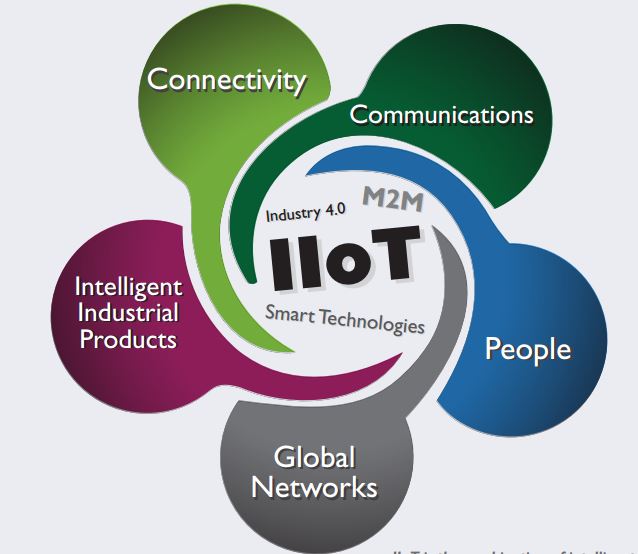
Industrial Internet of Things (IIOT) or industrial internet refers to the amalgamation of complex physical machinery with networked sensors and software. Industrial IoT brings together various fields such as machine learning, big data, IoT, and machine to machine communication to assimilate data from machines, so as to analyze it in real time and use it to manage operations.
Industrial Internet of Things (IIoT) is a scenario in which sensors, devices, and machines are connected with the Internet for enabling remote monitoring and control of industrial operations. This ability to control and manage assets remotely along with, increased cost savings through predictive maintenance is very valuable for industries. Its implementation can enhance decision making capabilities and also increase the collaboration within enterprises. Thus, Industrial IoT has the potential to transform industrial operations and provide greater competitive advantage for the companies.
The market associated with the Industrial Internet of Things is poised for tremendous growth. Sectors such as transportation and manufacturing have already begun adopting the same for their operations. Energy and power along with, oil and gas industries are deploying industrial IoT solutions primarily, for asset monitoring and predictive maintenance. Retail and healthcare sectors are expected to be the high growth sectors with regards to implementation of these solutions.
The Industrial IoT market size was worth $181.29 Billion in 2013 that is expected to reach $319.62 Billion at a CAGR of 8.15% from 2014 to 2020
Industrial IoT market is in the nascent stage and shows a great potential across different industry sectors. The market potential of Industrial Internet of Things is expected to grow with the global economy and contribute a significant share to the world’s GDP, in the coming years.
Cisco IBSG predicts there will be 25 billion devices connected to the Internet by 2015 and 50 billion by 2020
If 2015 has been the year of the Internet of Things (IoT), 2016 will see its widespread industrial adoption creating the Industrial Internet of Things (IIoT). While consumers are being dazzled by connected devices to manage their lives, the companies that build these devices are starting to use the same technologies to reinvent themselves. Manufacturing industries are quietly undergoing levels of change not seen since the Industrial Revolution.
But just how big will this really be? With estimates on IoT spending worldwide suggesting it will reach $15 trillion of global GDP by 2030, many have not realized that the IIoT is quietly accelerating at an even faster rate. One simple illustration can be seen in the number of sensors shipped globally in the last three years. It has increased more than five-fold from 4.2 billion units in 2012 to 23.6 billion units in 2014.
A key area that is starting to accelerate the change, particularly for automotive and industrial equipment (IE) manufacturers, is a maturity in the adoption of embedded software, which drives the connectivity of devices and sensors. In turn this provides the intelligence and actionable insight that characterizes the IIoT. As companies’ adoption of embedded software increases, they are going to see new benefits, starting with operational efficiency from the connected and intelligent applications of machines, products and people. That can increase productivity by up to 30 percent.
In addition, embedded software provides the foundation for innovation and faster time to market. In 2016, more companies will use it to build new business models by providing service add-ons, and bundling information services as subscription services that will contribute to R&D.
In 2016, we will also see the growth in what we call the ‘Outcome Economy’, built on the automated quantification capabilities of the IIoT. The shift is from selling products to selling measurable outcomes and this will redefine industry structures. For the more advanced manufacturers, this will enable companies to interact with a real-time supply chain and minimize talent shortages. This wave of embedded software adoption will also help fuel a second big IIoT-driven trend. With sensors and connectivity further increasing the availability of data, industrial and automotive players will adopt the next wave of analytics to create the agile and responsive business models to drive innovation and competitive advantage. It is all about the actionable insights.
As for the Analytics solutions, they are also becoming significantly more sophisticated. Yesterday’s descriptive analytics were historical, helping to quantify and confirm what has already occurred. Today’s more advanced, predictive analytics help companies understand what will happen in the future. In 2016, seeing trends as they develop will allow manufacturers to seize new opportunities as they occur, or even to get ahead of them. It also helps keep customers happy — and saves money.
As the excitement continues to build among consumers around the IoT, industrial companies are quietly reinventing and reorganizing themselves. Those that fail to realize the impact and extent of the Industrial Internet of Things do so at their peril.
Need help getting started with Azure or AWS IIoT Suite?